Walk With Us
Last year I worked with my cancer center and the non-profit Live By Living to start “Walk With Us”, a monthly walking group for patients with cancer in Denver.
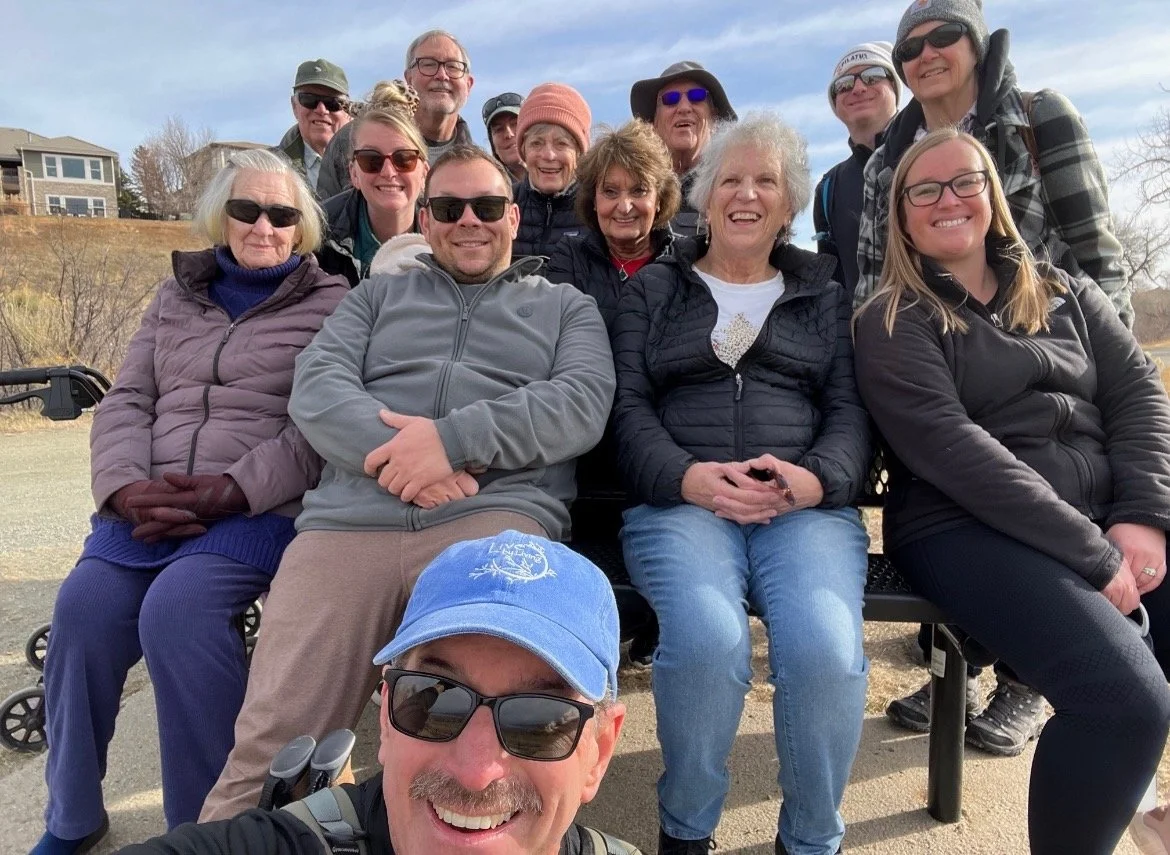
Our Walk With Us group, December 2025
The primary goal of the group is to help patients build and maintain an exercise habit. As an added benefit, the clinicians from our program join the walk to give patients the opportunity to ask about cancer and the science behind treatment.
Oncologists, especially Radiation Oncologists, should consider starting this kind of a program. You can walk the walk… role model a healthy lifestyle and fight misinformation by teaching patients about cancer and treatment.
Here’s what I learned while getting the program set up.
I didn’t invent this concept!
This all started with a volunteering goal, a desire to “help patients” and work on the radiation misinformation problem.
Luckily, the organization Walk with a Doc (WWAD) proudly displayed this great idea on a billboard that I passed almost daily commuting to work.
Even though I did not ultimately partner with WWAD for our walk, I cannot speak highly enough about this organization.
Bryan, their program manager, was a great source of information, and he connected me with a cardiology/cardio-oncology practice that hosts a walk in town.
Please consider supporting their cause by donating funds or starting a walk.
Considerations for efficacy.
These walks offer an opportunity to teach patients that exercise is scientifically proven to make them feel better. It might even help them live longer.
Our walk is 2-3 miles over about 2 hours. That’s 4-6 MET-hours, per Open Evidence. Patients can come learn the route and, if comfortable, come back and do it own their own.
Recall that the American College of Sports Medicine recommends a good starting point aerobic exercise prescription of 30 minutes of moderate-intensity activity, 5 times per week, about 7 MET-hours per week. This prescription is based on prospective studies demonstrating a range of benefits.
If patients do our walk twice a week, the evidence suggests that they should get the benefits.
You can make it more specific for patients by focusing on benefits for common symptoms, such as fatigue. Prospective studies have consistently found that walking the ACSM prescription for greater than 6 weeks improves cancer-related fatigue.
Finally, it’s important to remember that there is possible benefit even if patients cannot meet the ACSM goal!
Mattick et al. analyzed patient-reported quality of life data from a prospective study of women with breast cancer undergoing chemotherapy. Women self-reported leisure-time physical activity and fatigue symptoms (among other things) through a validated surveys at three time points: pre-chemotherapy, 1 month post-chemo, and 6 months post-chemo. Physical activity was converted to Metabolic equivalent (MET)-hours per week, and a receiver operating curve analysis was completed to find a threshold exercise volume associated with a meaningful improvement in cancer-related fatigue.
Methodological limitations aside, they found that activity >4.3 MET-hours per week is associated with less fatigue.
That would be about a 1-mile walk over 1 hour just twice a week!
Considerations for starting a walk.
A clinician can set up a walk and run a walk on their own or with a small team. They need to complete small advertising/administration tasks, find some kind of liability coverage, and scout a safe, inclusive place to walk.
Our walks are advertised internally, a navigator hangs signs in our clinic (thanks Kathy!) and clinicians recommend it to their patients. Live By Living also advertises the walks on their calendar and we put it in some newsletters. Someone needs to set up fliers and sign up sheets for each event as well as collect liability waivers from participants. Live By Living was already administering walks for my cancer program, so Walk With Us piggy backed on that agreement.
Walk with a Doc offers a turnkey solution for advertising and administering a walk, including liability coverage. For a lower effort alternative, check out their map and consider collaborating with a walk that already exists in your neighborhood.
If you’re starting a new walk, seek out a 2-3 mile flat route without a lot of hazards such as stairs, tree roots, and rocks. We use the High Line Canal in Denver, a wide, dirt trail with flat sections in the neighborhoods of our hospitals. Ideally, it will be easy to park with a safe path from the parking lot to the starting point. Others can and do host walks in urban environments as well.
Live By Living does a great job of providing technical information about the walk on each sign up page. The walk leader’s cell is also provided (excluded here for privacy).
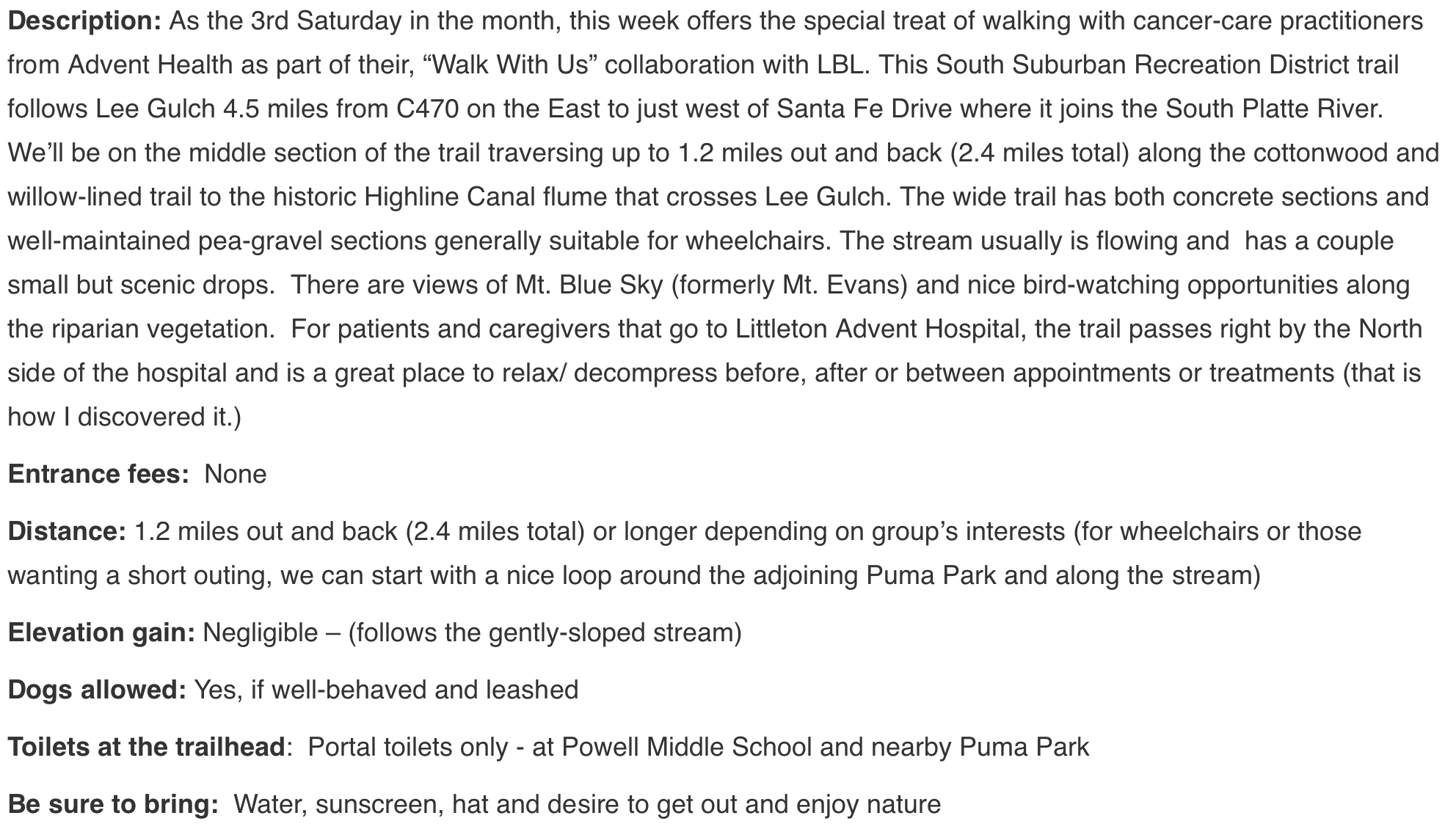
Information page for a recent “Walk With Us”
Go Direct-to-Patients With Exercisumab
Physicians that are passionate about exercise as medicine are understandably frustrated that it’s not a drug. It’s challenging to deploy exercise interventions at scale in cancer centers without the enthusiasm of university labs, federal funding, or pharmaceutical industry research dollars.
On the other hand, exercise is an opportunity to help our patients directly, free from the crushing weight of the bureaucracy that usually surrounds launching therapeutic programs.
If I can help you in any way, please feel free to reach out.